PRODUCTS
We invite you to browse through our product portfolio and compare it against the competitors. We are sure you will agree with us that there is simply no comparison.
- PCI Express Digitizers
- ATS9373 - 12 bit, 4 GS/s
- ATS9360 - 12 bit, 1.8 GS/s
- ATS9364 - 12 bit, 1 GS/s
- ATS9371 - 12 bit, 1 GS/s
- ATS9872 - 8 bit, 1 GS/s
- ATS9362 - 12 bit, 750 MS/s
- ATS9352 - 12 bit, 500 MS/s
- ATS9353 - 12 bit, 500 MS/s
- ATS9628 - 16 bit, 250 MS/s DC
- ATS9462 - 16 bit, 180 MS/s
- ATS9428 - 14 bit, 250 MS/s, DC
- ATS9416 - 14 bit, 100 MS/s, 16ch
- ATS9442 - 14 bit, 125 MS/s, 4 ch
- ATS9440 - 14 bit, 125 MS/s, 4 ch
- ATS9146 - 14 bit, 125 MS/s, 2ch
- ATS9130 - 12 bit, 50 MS/s, 2ch
- ATS9120 - 12 bit, 20 MS/s, 2ch
- Thunderbolt 3 Digitizers
- Software
- Chassis
- Legacy Products
- ATS9870 - 8 bit, 1 GS/s
- ATS9350 - 12 bit, 500 MS/s
- ATS9351 - 12 bit, 500 MS/s
- ATS9625 - 16 bit, 250 MS/s, AC
- ATS9626 - 16 bit, 250 MS/s DC
- ATS660 - 16 bit, 125 MS/s
- ATS460 - 14 bit, 125 MS/s
- ATS330 - 12 bit, 50 MS/s
- ATS310 - 12 bit, 20 MS/s
- ATS860 - 8 bit, 250 MS/s
- ATS850 - 8 bit, 50 MS/s
- AlazarStream 8000
- ATS-VI
- ATS-GMA-BASE
- ATS-GMA-OCT
WELCOME OCT NEWS READERS
AlazarTech provides waveform digitizers (A/D boards) and software solutions that allow OCT users to digitize electronic waveforms generated by their MZI, perform real-time data transfer to GPU for DSP, and easily create live images in their custom imaging software.

AlazarTech reduced prices on many digitizers in July 2024. Request pricing.
Volume discounts also available. Contact us for more information.
Our digitizers support direct k-clocking or non-uniform FFT.
30-day "Try before you buy" evaluations: Your organization may be eligible for a risk-free trial of AlazarTech products.
Now available: ATS-GPU trial version. The ATS-GPU software library for GPU-based DSP is now available on the 30-day "Try before you buy" evaluation program.
Click here to find out whether your organization is eligible for this program.
All AlazarTech PCIe and Thunderbolt 3 waveform digitizers are compatible with ATS‑GPU for GPU-based DSP. Use ATS‑GPU‑OCT for out-of-the-box OCT imaging. Get ATS‑GPU‑OCT specifications & pricing.
Direct k-clocking has been a popular method of acquiring data in an SS-OCT system. k-clock signal from the MZI is used by AlazarTech's A/D converter IC to acquire data that is linear in k-space. This saves an immense amount of FPGA or GPU resources that would need to be used to linearize the data post-acquisition. We have also heard from large volume customers that direct k-clocking is more stable from laser-to-laser than acquiring k-clock as an analog input and using it to linearize acquired OCT signal. Problems reported were instability of k-clock phase in the first 15 minutes of power up; and the need to do filtering of k-clock signal before using it for linearization. In all these cases, using "Direct k-clocking", i.e., using k-clock as the A/D sampling clock solved the customer's problem.
One popular complaint about k-clock being output by a swept source is that it is fixed in frequency and, therefore, limits the image depth. AlazarTech has developed dual-edge-sampling (DES) logic on its waveform digitizers that will effectively double the sampling rate and hence the image depth.
Cost benefits of Direct k-clocking include the possibility of using a lower cost A/D converter and lower cost FPGA
If your OCT system must operate on a 24/7 basis, you need to use AlazarTech products.
AlazarTech provides a complete solution for SS-OCT applications, including:
- Low Noise High Resolution data acquisition at fast sample rates With up to 4 GS/s sampling offered by ATS9373, you can future-proof your OCT system for tomorrow's sources
- Fast 6.9 GB/s data transfer rate for raw (time domain) data or FFT data There are OTHER companies claiming to offer OCT solutions, but their data transfer rate to computer memory is only a few hundred Megabytes per second, putting a ceiling on how many frames per second they can capture
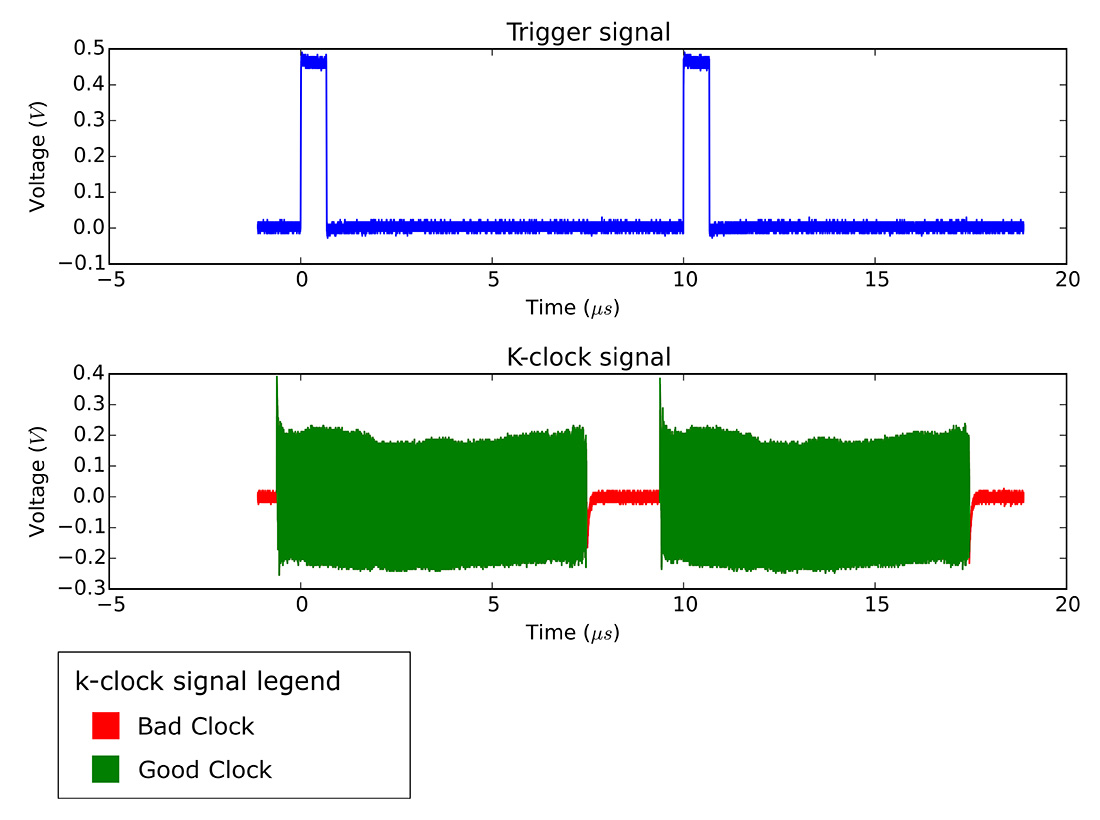
- Support for variable frequency external clock to allow the use of the swept source's k-clock to solve the re-linearization problem This feature is unique to AlazarTech due to our unique A/D technology. Commercially available A/D technology requires fixed frequency sampling and, therefore, cannot use k-clock signals from swept sources. A DSP-based resampling scheme must be used to linearize the data in k-space. Our k-clock based solution directly generates data linear in k-space
- Unique OCT Ignore Bad Clock feature that allows use of out-of-specification k-clocks k-clock from many swept sources provide either no signal in between scans or a "dummy clock" of very slow frequency. In some cases, the "dummy clock" can also contain glitches. AlazarTech's OCT Ignore Bad Clock technology allows the user to tell the A/D circuitry to ignore the k-clock signal during a certain time duration after each trigger
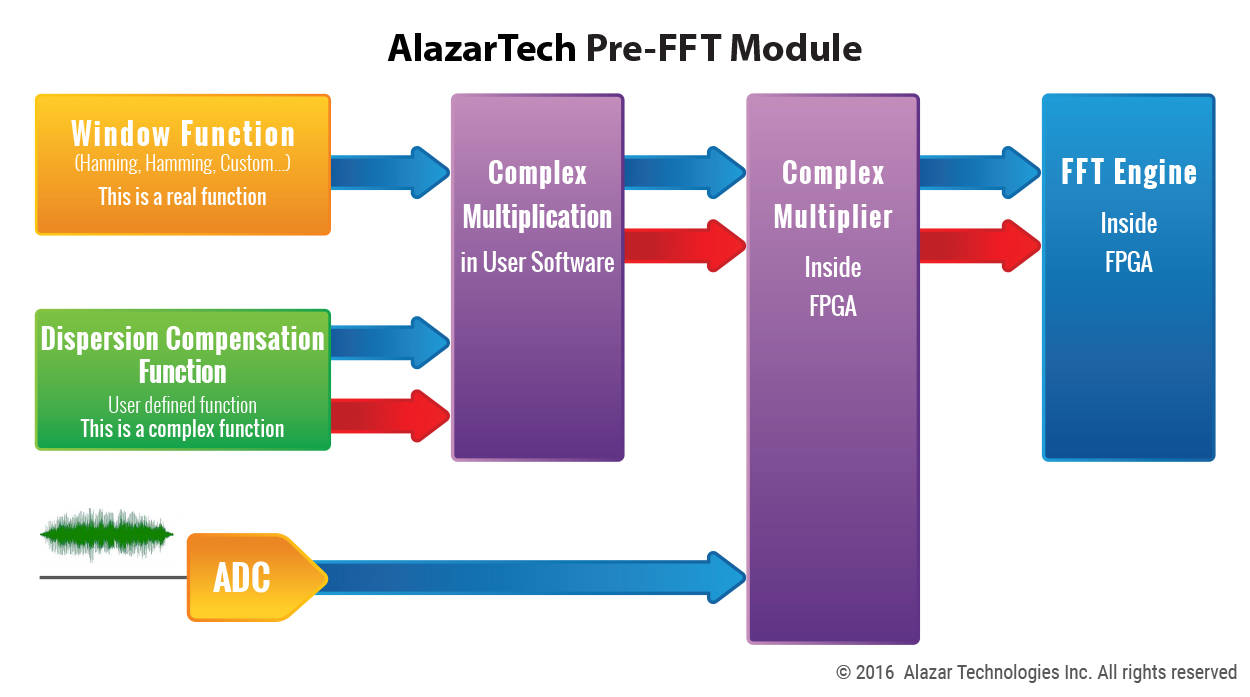
- Complete On-FPGA FFT solution that includes: • User programmable dispersion compensation function
• User programmable windowing
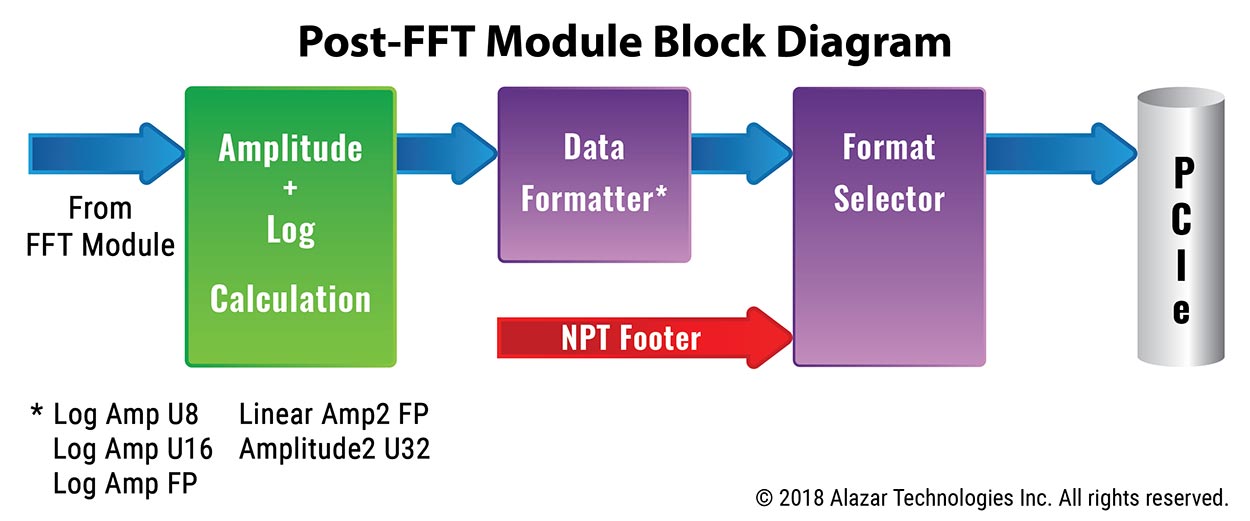
• Log calculation
• FFT magnitude output in floating point or integer format
- Special "Raw + FFT" mode that allows users to acquire both time domain and FFT data This can be very useful during the validation process
- Embedded data footers that include timestamp, frame count and many other useful information for each record